
When things get rough - PIVOT!
Writer's block, burnout blues, creative chaos - it's your brain telling you it's time for a change.


I think it was the way I would find anything else I could do other than revise the book that had been sitting on my computer screen for the last three hours. That’s what gave me the clue I needed to change things.
The signs of burnout were all there, like a word cloud in my mind. I was getting to it. Exhausted, with my sleep schedule all over the place, the thought of pushing myself to handle the revisions annoyed me, while the idea of going out and having fun made me cringe. I felt helpless, a slave to my brain.
And that’s when I knew it was time for a change. For those of you who know the scene from a famous television show where Ross gets a huge sofa, but then has to coach his friends through carrying it up a few flights of stairs, you know where I got the exclamation, “Pivot!” from.
That was me, myself, and I screaming as I finally set up a scheduled timeframe daily to get those damned revisions done. I pushed away all distraction and for the month, my goal was to finish that book, no matter what!
And I did it.
But, man, was it tough. After it was done and I’d clicked “Publish,” I had to take a long, hard look at what I had done to myself. I didn’t just have the symptoms of burnout; I had the worst case of writer’s block.
I could see my next writing project, but it was behind an entire minefield surrounded by barbed wire and flanked by armed guards with ferocious dogs. That wouldn’t do.

I’m writing this, in an effort to help other creatives STOP before they reach this level or beyond. Please don’t do this to yourself. And if I’m too late? Well, maybe my solutions can help you, too?
I had to pivot away from my chaos. With ADHD, at least my particular flavor, I mix it in with a bit of anxiety and depression and sometimes see the world through lenses that are very unkind to me. That was a problem. The chaos made things worse.
I reorganized everything around me as well as I could. And once I was comfortable with my physical surroundings, I settled in with my planner, a spare notebook, and a smaller planner I’d gotten recently.
If I wanted to keep up my goals: sharing my stories and making a living with my writing, so I can continue to work on my stories and not have to deal with a public-facing job (mostly what I am qualified for), I have to put in the proper effort, change my habits, and keep it going.
When I couldn’t decide where to go with the YouTube channel, I placed a poll for my community. I needed input from the people who matter the most for that platform—my viewers. To get my articles back on track for Medium, where I made money from publishing, I knew I needed to assign myself a specific time for focus. When the polls were done, I realized people also wanted more aggressively helpful writing advice. So, two articles per week is the goal.
By the way, people also want more Blurbing with Rach. If I get some clients willing to come on-air with me for a discount, maybe I will. It’s a lot of fun. Or maybe I can run some giveaways at some point? Who knows…
The other poll finished, letting me know everyone wanted sprints at night, not during the day or morning. At least, not my regular viewers. So, that’s why I’m currently typing up my first article in months during a sprint stream I scheduled from 9PM EST - 11PMEST. Sure, I’ll hop on for Pop-Up Sprints, but for the most part, this is it.
As I type this up, I’m already making note of what to film during my production day, which will be every Wednesday. I actually wrote the word “production” on the calendar in the planner. There will be videos to go along with the articles. I also want to create some of these videos for my readers as well. I want to enjoy the other side of YouTube. For that matter, I can begin processing book ads and quote slides.
Why? Because I created a side-channel specific to readers while the first channel remains Authortube-centric. Will it remain that way? I’ve been told that it should. Readers don’t always want to hear about the writing process. They want to hear about the stories, the world, the characters, and your plans to entertain them. I get that.
So, with my planner out, I began making those plans. I got the printed sheets I use from Sarra Cannon’s HB90 (I don’t use all the program, but what I use works for me). First, I figured out how many hours a day I have for writing and creating marketing. I also pre-assigned the time I stream sprints for article writing and collaborative writing. I assigned myself breaks for walking, cooking, and chilling out so my mutant eyeball doesn’t get angry with me.
Knowing how much time I realistically have helps me rearrange my schedule for book releases. I need to get those stories that complete the series out in the first half of 2026. Since I rely on other people for those, I had decisions to make. The process made me realize I couldn’t conceive of everything at once without seeing it. I needed to go back to using a physical Kanban board.
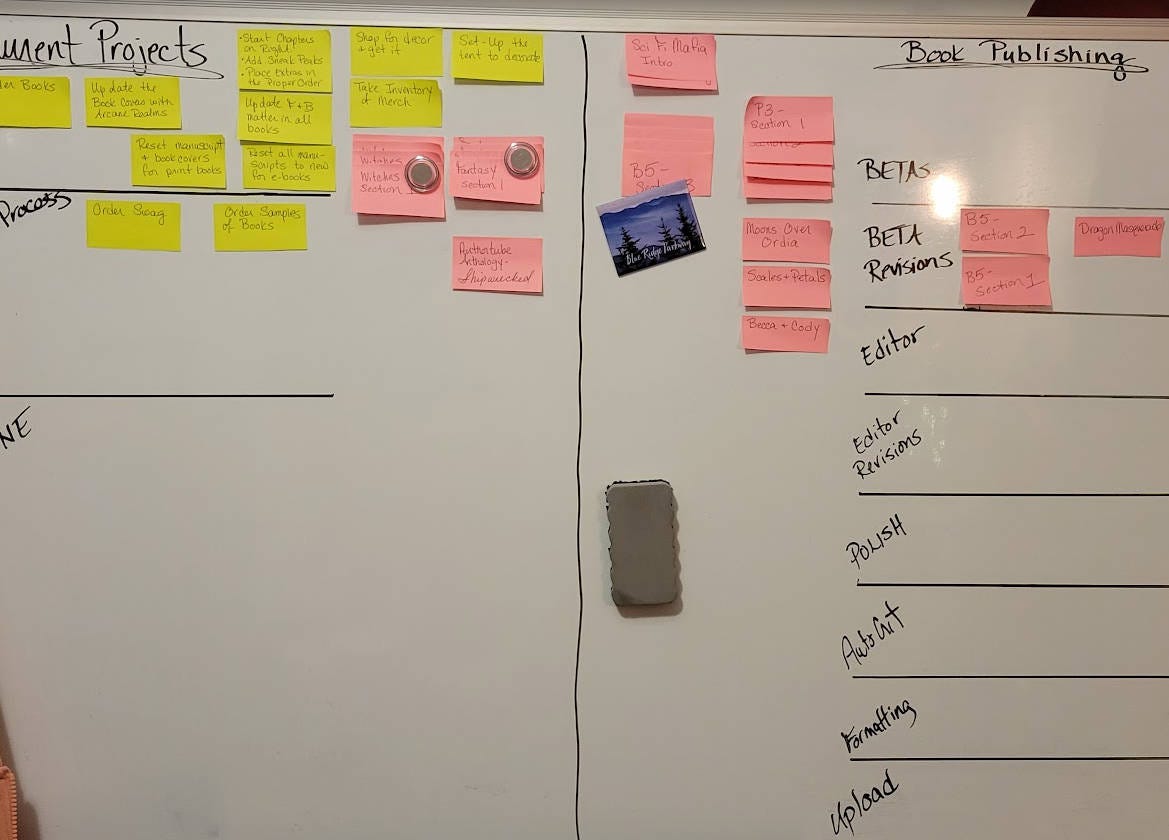
I wiped down one side of my flippable whiteboard and got to it. Now have a portion of it set up for novels to publish and the other side set up for everything else. I can see my goals and how far I’ve gotten with them and where each task and project is sitting. This means I am driven to complete them. It means I know who to contact if things are taking too long. I will get them done.
Another change I made is in lifestyle.
Since I take so long to focus in the morning, and I often wake up with a headache, I need to give myself that grace. I got up this morning, and instead of rushing to my office, I enjoyed some water and a light breakfast before watching a podcast that actually made some points that I plan on using. While I watched, I did my core exercises. I got dressed instead of staying in my PJs. I went to work prepared to actually get things done.
And I did.
One thing that has always helped me follow through on changing my habits is recording things. I got my first two books done so quickly because of recording the time I put into them to show myself how much I was working. It also helped me see when I needed a break. Eating is the same. I ate healthier by recording it daily. I could also pinpoint problematic foods or habits that way.
Recording things will be the next reapplied habit I pivot to.
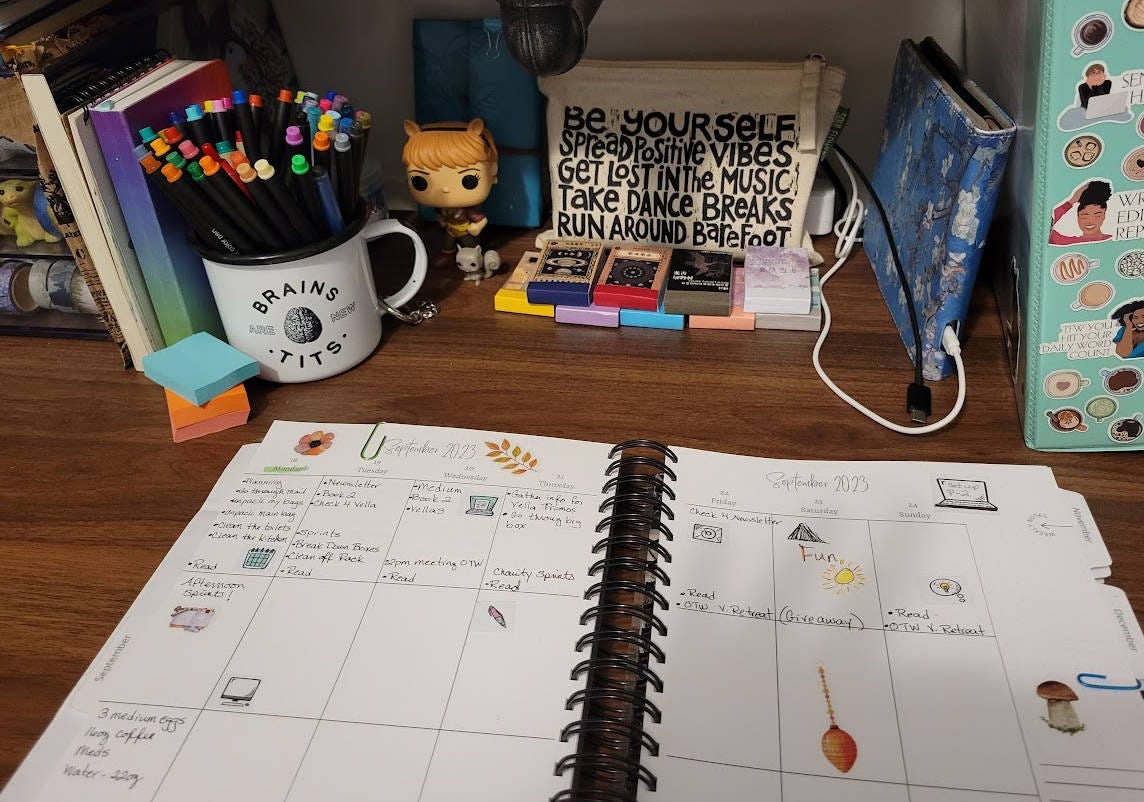
Recording your time worked also helps restructure your brain to value production time over completion. It’s going to take me a long time to finish a novel. A long time before I get the dopamine hit from taking the note from the Kanban board. But I can get a small rush by marking down that I wrote for a full half-hour time slot. When I finish 16 thirty-minute time-slots, that’s a full day’s work. I feel like I’ve accomplished something measurable despite not completing the project.
I used to get out of my office to write. I’d write in my living room while listening to music and watching YouTube - writing ideas for future content as I’d go. Or, I would go people watching at the local coffee shops and restaurants that allowed a work laptop for a couple of hours. Just the change of scenery helped, and I’ve become a hermit. That needs to change.
Just writing something other than the series is helping. I’ve journaled, and I’ve researched for this article, and now I’m writing it. It’ll rest overnight, and then I’ll edit tomorrow. I may even publish it once I create a video outline from it. But that is time spent creating something that could help someone else and also make me some money. It takes my mind off of the project that put be dangerously close to burnout.
So, yeah, pivoting is essential. It is healthy. You just need to be willing to do it.
If you have any other suggestions or personal experiences to share, please feel free to leave a comment! We are here to support one another!
Catch me on Authortube or Twitch and also check out other articles that might help you on your author and writing journey!
Yes! Pivot. I get the visuals, and need them, too. I've created a small checklist of daily habits. It helps. Fot one, it shows me I'm actually getting something done that I set out to do that day. Second, that dopamine hit from checking it off gives me energy.
Yeah pivoting is crucial. I recently changed how I approached my tasks by bringing in a new ritual. It's definitely helping me get back on track and keep going hours after I usually want to stop.